

Preschool: A solution to a problem you don't have
Recalibrating our educational imagination

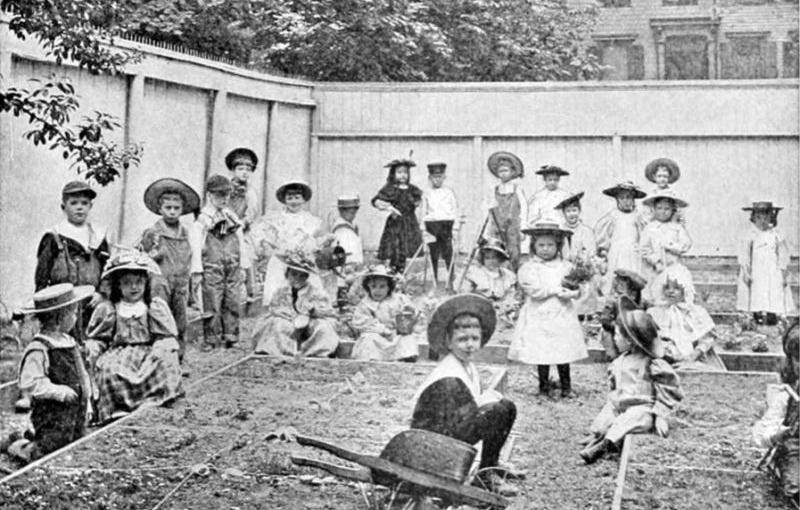
Anyone coming to homeschooling from a public-school background will tell you that half the battle is recalibrating their educational imagination and the resulting ideas of what school “ought to be like.” Sometimes a remainder from secular educational imagination gets imported into homeschooling on a wide scale. I would argue that this is the case in how the broader home-ed world, as represented in the likes of the Rainbow Resource Catalogue, approaches the purpose of the preschool and kindergarten years.
Kindergarten – teaching pre-school children through play, crafts, songs, and movement – was pioneered by Friedrich Froebel in 1830s Germany. (Though, interestingly, Froebel did not advocate teaching kindergarteners to read or write.) The concept of preschool likewise did not exist until the 1800s, taking off in the early 1900s. And even then, the typical age of a child’s first formal reading lessons remained 5-7 until the late 1900s, when we started using words like “neurological” and “outcomes.”
Neither kindergarten nor preschool arose as a solution to a crisis of academic preparedness. Nobody prior to the 1800s was saying “man, these six year olds coming into first grade just don’t know their colours or shapes.”1 Or “If only someone had taught these kids to read when they were four, they’d be miles ahead by now.” Rather, the mainstream adoption of formal early years education provided a solution to the problem of what to do with young children during working hours.2 This problem was created by the industrial revolution: longer working days, two parents working, and the move from rural family-based work such as farming to more atomised factory-type work.
Preschool and kindergarten, while not discounting any merits they have, are quasi-educational babysitting services. They are solutions to a problem that I, and anyone else who stays home with their small children, do not have.
Rid of the problem, we can likewise be freed from its solution. So many things we think we “should be doing” in these years are things that schools do to keep the children occupied in a “constructive” manner. We see them on Pinterest – the colour-coordinated letter matching games, the sorting bins, the simple addition hopscotch.
I’m not trying to make anyone feel bad about working through a standard preschool or kindergarten curriculum, or whipping up a sensory bin, especially if everyone involved enjoys it. I don’t want to be mistaken for the free-range, unschooling mom you meet in the woods (you know, the one with an eight-year-old named Cloud who can’t read) who says that learning-based crafts are more than a child needs. I think it is actually less. If a cute curriculum with phonics, colour-matching, and simple addition is the extent of a small child’s education, the actually important stuff is being overlooked.3
What is the important stuff? According to C.S. Lewis, the “necessary point of departure” is to give your kid a chest.
Until quite modern times all teachers and even all men believed the universe to be such that certain emotional reactions on our part could be either congruous or incongruous to it—believed, in fact, that objects did not merely receive, but could merit, our approval or disapproval, our reverence, or our contempt. The schoolboy who reads that the waterfall is sublime and then is encouraged to think that this only means that the author has feelings associated with it is being trained to believe that all such responses are subjective. But the task of the modern educator is not to cut down jungles but to irrigate deserts. The right defence against false sentiments is to inculcate just sentiments. By starving the sensibility of our pupils we only make them easier prey to the propagandist when he comes. For the ordinate affections are the necessary point of departure in true education.
C.S. Lewis, Men Without Chests
These ordinate affections are the “chest” (heart) that connect the head (reason) to the belly (desire), and it is this chest that Lewis says is missing in the modern man. Ordinate affections means simply loving what is beautiful, believing what is true, doing what is good. But in order to love what is good, one must first have the ability to recognise what is good. A suitable word for this ability would be intuition – the student’s most basic impulses. What will they gravitate toward? What will they be repelled by? Where does their moral compass point? Do their emotional reactions, positive and negative, align with reality?
A cultivated intuition is of foundational importance, if Lewis is to be believed, and ought to occupy a primary place both in terms of time and attention and actual chronology. As it happens, young children are uniquely capable of developing fierce loves, loyalties, and suspicions. These intuitions can be learned later in life, but it require more effort, like trying to learn French as an adult vs having it spoken to you from the time you were born. Children’s minds and souls are fresh, soft, and easily imprinted upon. The early years are vital.
It is easy to let a curriculum balloon to take the place of real education stuffs, partly because it provides a sense of comfort and also because it appeals to our desire to measure things. A page of homework can be checked off a list. It is measurable progress. Whereas a day spent listening to Tchaikovsky at breakfast, reading a stack of picture books on the sofa, reciting nursery rhymes in the garden, spelling the word CAT during lunch, spotting birds on a walk, singing a hymn in the evening before bed, is difficult to quantify.
Really making the most of the early years has almost nothing to do with getting a jump start on reading and sums, and everything to do with “tun[ing] the soul and mak[ing] it receptive to truth and goodness.”4 Scissors and glue sticks might be involved, but they don’t have to be.
It is concrete bits and pieces, angles and fragments of this broad and unquantifiable aim that I hope to mostly write about.
Further Reading/Listening for the Overachiever
The Abolition of Man, C.S. Lewis.
The Liberal Arts Tradition, by Kevin Clark and Ravi Scott Jain. Particularly Part I on Piety and Poetic Knowledge.
Emily Phillips has an excellent post on how to resist modern neurosis and simply be happy at home with your littles.
Mystie Winckler and the other Scholé Sisters did a great podcast on “The Wonder Years.”
My fellow Americans may notice the spelling of “colour,” or a number of words that have S instead of Z. This is solely because my laptop is British and annoys me with red squiggles if I don’t conform. So leave me alone.
Early kindergarten initiatives in the US were also driven by socialist welfare ideals.
“But they have to learn how to sit still don’t they?” I can hear someone saying. They do. I’d like to write about this too, but it will have to be a different time as this post is already too long.
The Liberal Arts Tradition, Kevin Clark and Ravi Scott Jain.
Very true. My mother was a certified teacher when she decided to homeschool my siblings and me in 1982. Her first six weeks were extremely stressful to the point of nightly tears, because she was trying to import “school” into the home—and it didn’t work. We had a “schoolroom” with desks, a chalkboard, and a teacher’s desk for Mom. But with only three of us to teach (and my sister was four years old), the absurdity quickly became apparent. My father stopped her six weeks in and asked her why she was trying to stick with a model she had wanted us freed from. That’s when Mom threw out the “school in a box,” jumped my brother two grade levels ahead in math and pushed me back one grade level, since I struggled where he didn’t. My little sister got to enjoy genuine playtime instead of pre-school. As the years went on, Mom relaxed more and more as she saw we would gladly pick up topics that fascinated us and pursue them without being pushed or cajoled. But my very favorite memories are of listening to “Eroica” on the record player, gardening with Mom, and learning to piece together a pattern to make a new dress. It was hands-on real life that we loved, and the learning flowed out of that. It was scary for Mom to let go of all the teaching rules she had learned (and don’t get me wrong—she was still very organized and methodical), but it gave us the freedom to enjoy each day as a new adventure together. That is a great gift.
Love this! Thank you :)